¶ How Does E-Drive Work?
¶ Power Generation
E-Drive generates power in a carefully controlled manner, it constantly monitors system and battery voltages, current, temperature and engine state to efficiently generate power suited to the conditions.
¶ A Healthy and Efficient Engine
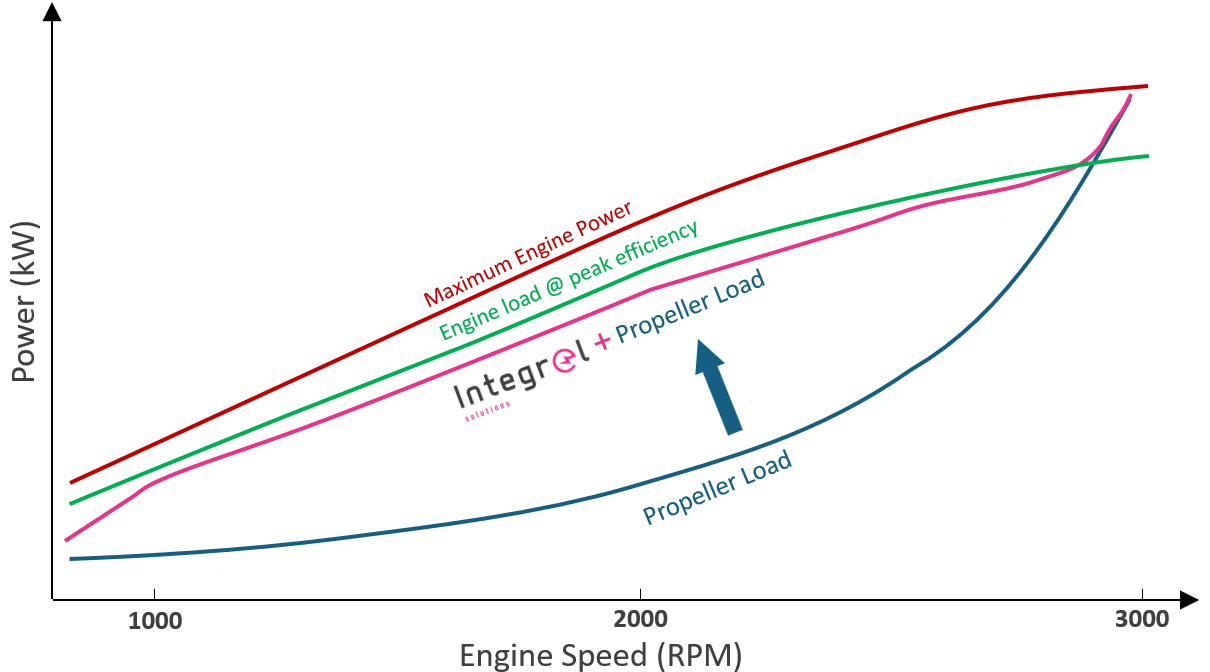
E-Drive makes an engine run more efficiently which keeps it healthy. Consider the graph below which shows engine output power and engine loads over the full engine RPM range. Without E-Drive, the propeller (blue line) uses much less power than the engine (red line) is capable of producing over nearly the entire range of engine speeds. Engines have poor fuel efficiency when the engine load is low.
Using Integrel E-Drive, the combined propeller and E-Drive generation load brings the overall load on the engine much closer to peak fuel efficiency.
The result? The engine runs more efficiently, is healthier AND generates large amounts of energy with near optimal fuel usage!
¶ Power Generation vs. Engine Speed
The amount of engine power available for charging initially increases as the engine speed rises. Generation power typically peaks in the 1900 – 2200 RPM range and then reduces as engine speed approaches wide open throttle to ensure the propeller gets the power it needs to drive the boat. This behaviour is shown in the following graph that depicts the power output of a dual E-Drive system. The specific optimal RPM range will vary from boat to boat, depending on the engine, hull form and type of propeller fitted.
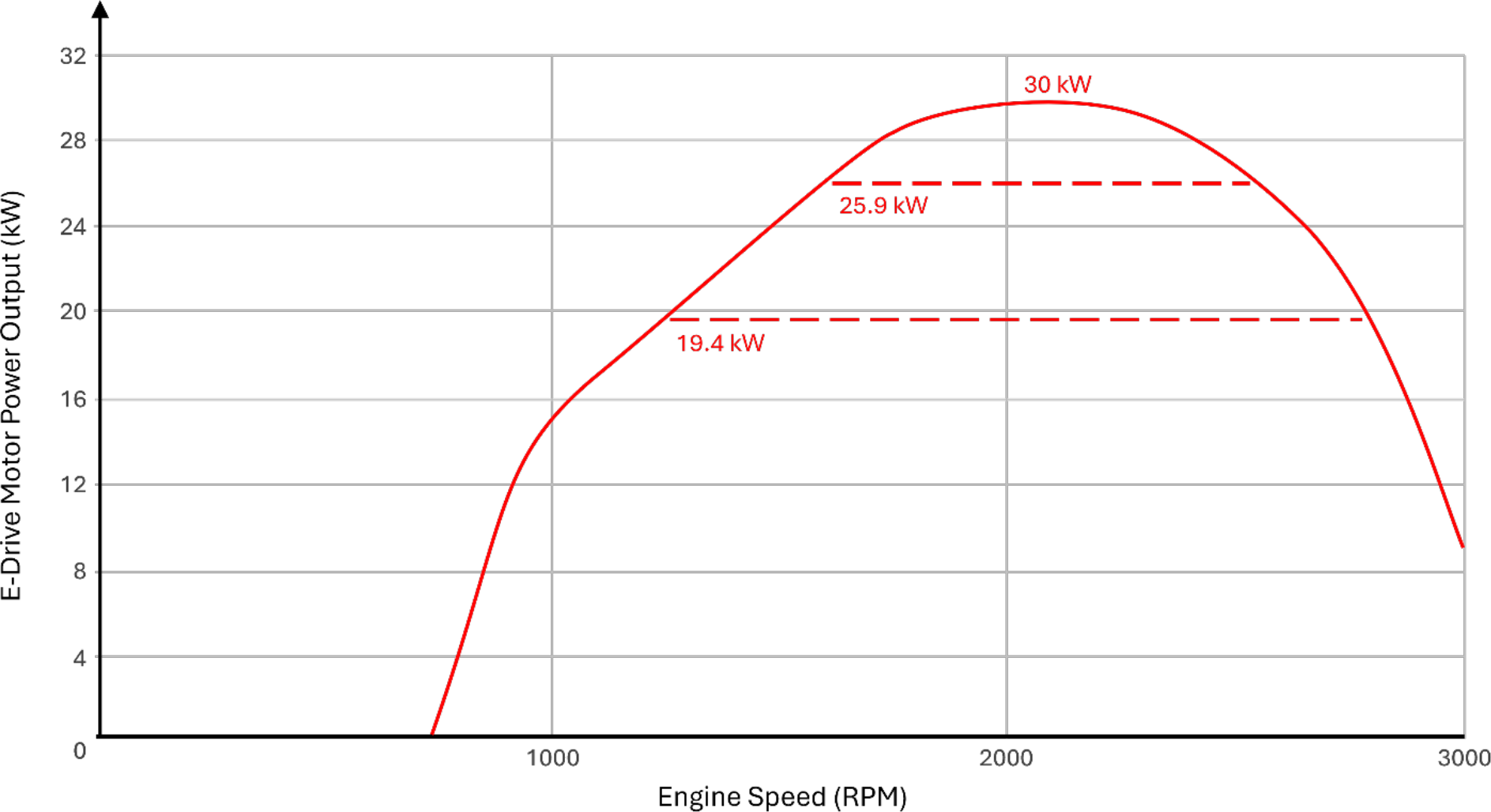
Depending on the capacity and configuration of the 48V battery bank, the maximum charging power for a dual E-Drive system is around 30 kW. However, some battery banks are unable to charge at 30 kW, so the E-Drive system limits charge power to avoid overloading the batteries.
Consider an example where the battery bank incorporates three 48V battery strings in parallel (shown in the picture below), with each battery string configured to accept 120A current while charging. Note that during charging, 48V (nominal) batteries quickly reach a terminal voltage of at least 54V.
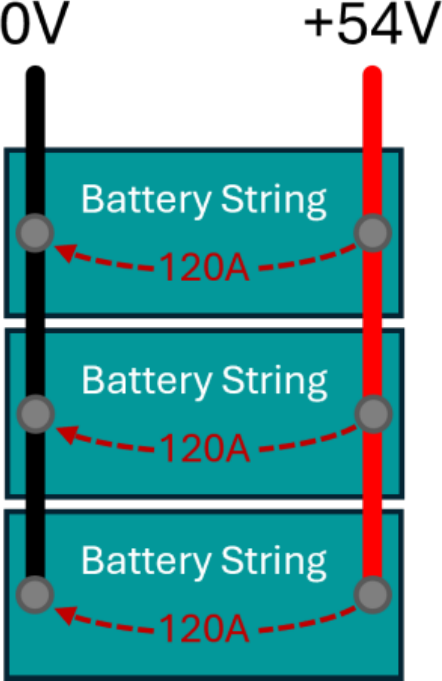
To calculate the battery charge power, the combined maximum current in each string is multiplied by the terminal voltage. So, a battery bank with three strings of batteries charges at a rate around 19.4 kW (= 3 x 120A x 54V).
A larger bank with four strings of batteries charges at a rate around 25.9 kW (4 x 120A x 54V).
¶ Power Generation vs. Temperature
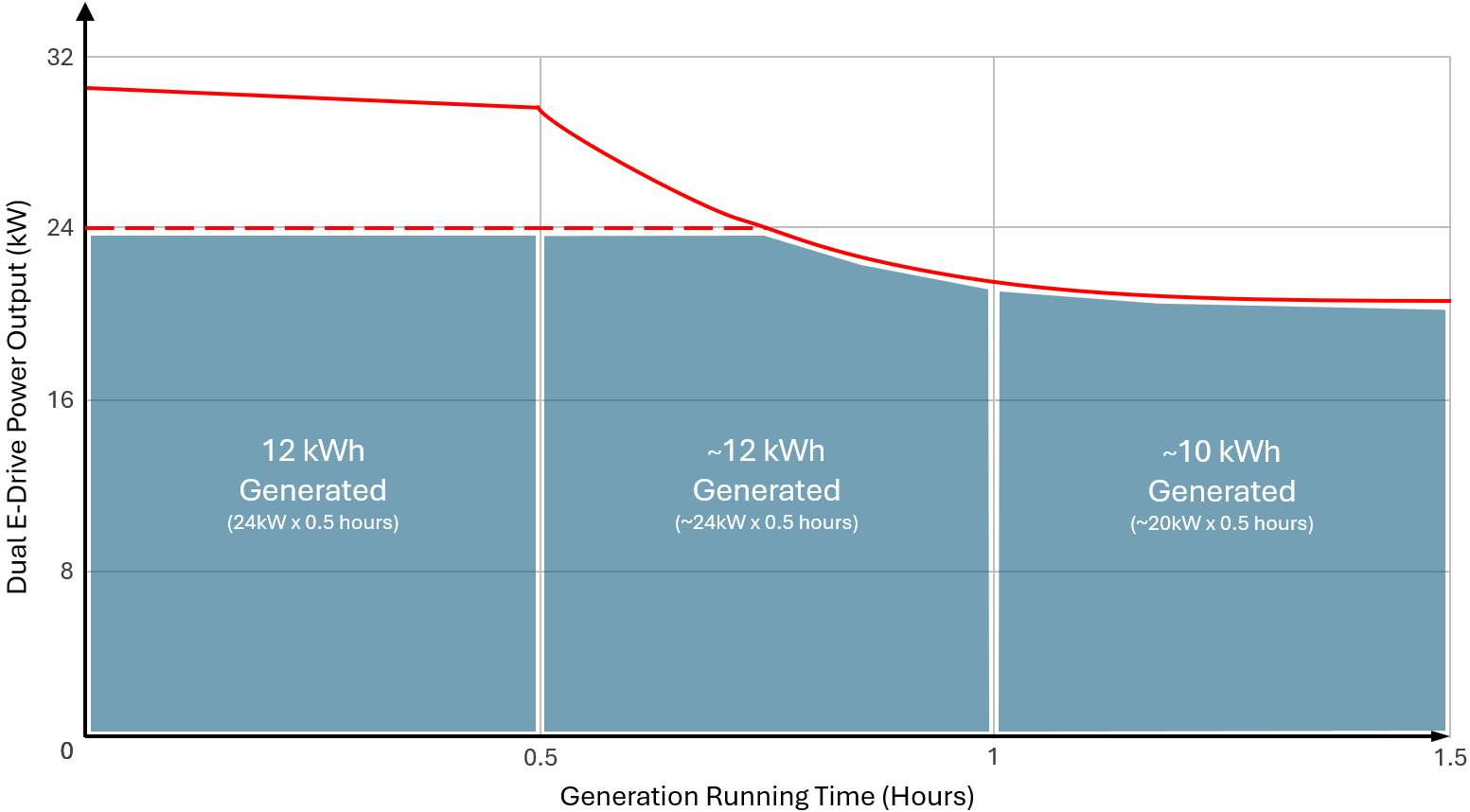
The E-Drive motor is air-cooled and heats up with time as it generates power. When the motor reaches maximum operating temperature, power generation output is reduced to avoid overheating depicted by the solid red line in the following graph.
If the maximum power generation is limited to 24 kW (shown by the dotted red line), the system generates power at 24 kW for the first 45 minutes (0.75 hours), and the power output then reduces slowly to around 20 kW thereafter.
In this example, the system produces nearly 34 kWh in under 90 minutes; enough to boost the state of charge of a 48kWh battery bank from 15% to 85%!
¶ Prioritising Propulsion
Each E-Drive motor can generate up to 15 kW of electrical power from the engine. As a result, it is critical that the additional load on the engine is carefully managed to ensure propulsion is always prioritised. The E-Drive control system automatically adjusts the engine load which may sometimes result in a slight change in the sound of the engine. The additional load makes no difference to the boat speed on a modern engine with electronic governing. On older engines with a mechanical governor, the engine RPM may drop slightly.
The E-Drive system immediately pauses power generation when a gear shift is detected or there is a rapid change in throttle demand or engine speed (RPM). This behavior ensures that when the boat is manoeuvering, or in circumstances where propulsion is required immediately, the entire engine power is available to drive the propeller.
Generation is also prohibited when the engine is below minimum operating temperature and as the throttle approaches full ahead / full astern. When the system senses the engine is in a steady state, or the engine speed is changing slowly, power generation resumes.
The E-Drive system never allows the generation load to push the total engine load (propulsion and generation) above 80-85% of the total engine power at any speed. This operation is handled automatically.
In summary, E-Drive automatically generates power while simultaneously ensuring that full engine power is instantly provided to the propeller when required.
¶ Electric Drive
The E-Drive system uses the E-Drive motor in a carefully controlled manner, constantly monitoring system and battery voltages, current, and temperature to efficiently drive the boat based on throttle demand and battery state.
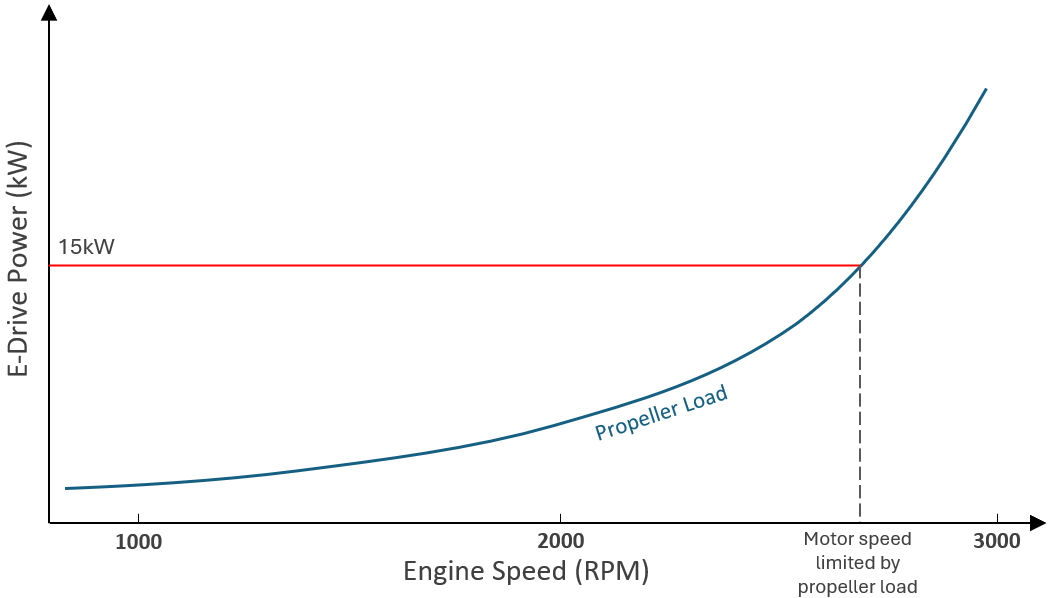
The load of a propeller increases exponentially with propeller speed as shown by the following graph. It is much more energy efficient to use electric drive at low to mid-range propeller speeds, and much greater ranges are achieved when E-Drive is operated in this manner.
E-Drive speed, and thus propeller speed, is limited by the propeller load at wide open throttle. The maximum achievable speed depends on the type of propeller used, together with the shape of the hull and boat displacement.
Operating E-Drive ⟵ | User Guide Contents | ⟶ Alerts and Notifications