¶ Operating E-Drive
¶ How to Generate Power?
Power can be generated when the engine is running with the gearbox in neutral, or when the engine is in-gear driving the boat. If the engine is in neutral, all of the engine power is available to generate power, but if the engine is in-gear, available engine power is reduced because some of the engine power is used by the propeller to drive the boat.
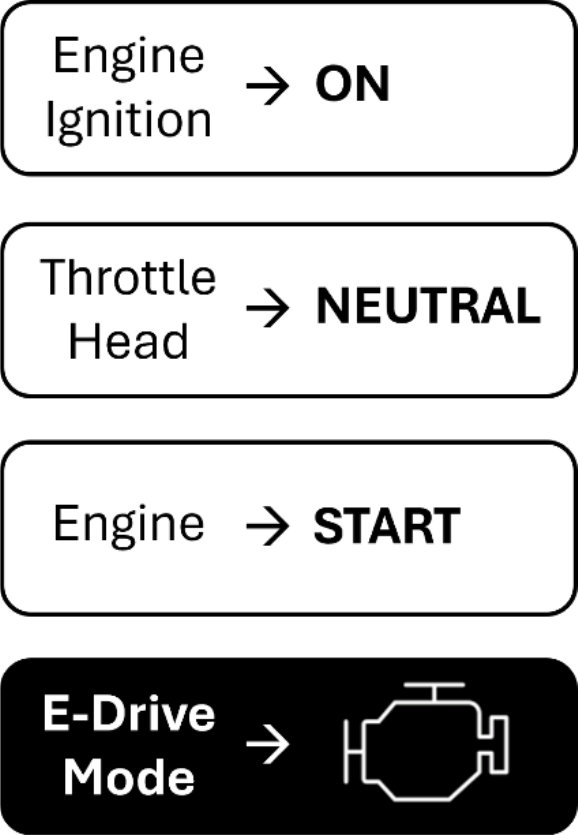
To generate power:
- Turn the engine ignition on.
- Move the throttle to the neutral position.
- Select Generation Mode on the E-Drive screen.
- Wait until the System initialising dialog is no longer shown on the user interface
- Start the engine.
- Move the throttle into forward (or reverse) idle, then increase the throttle demand as required.
Note that E-Drive generates power whether the engine is in neutral or in-gear, however when the engine is in-gear, generation starts after a short delay as explained in What Limits Power Generation?. There is also a short delay after the engine is started to allow the RPM to settle at a stable idle.
After throttle demand stabilises, power generation ramps up to:
- The maximum power charging limit of the batteries, OR
- The maximum available power from the engine at the given RPM OR
- The maximum power generation limit set on the E-Drive screen, OR
- The maximum power generation capability of the E-Drive motor at the given RPM
Generation continues until:
- The battery state of charge reaches the maximum charge limit set on the E-Drive screen, OR
- The battery indicates it is unable to continue charging; typically because the battery has reached a maximum charge limit.
¶ What Limits Power Generation?
The power generation output level depends on a number of factors, including:
- Throttle demand. E-Drive generally produces higher power output as throttle demand is increased. Generation is most efficient with the engine running in the range 1900 - 2200 RPM. As throttle demand approaches 100%, power generation is reduced so that all engine power is given to the propeller for propulsion.
- Available engine power. The engine produces more power at higher speeds, but the propeller load increases at higher speeds also; so the available power from the engine varies with speed. This behaviour is shown by the graph in the section titled How Does E-Drive Work?
- Battery charge capability. E-Drive limits power generation to the maximum charging limit recommended by the battery manufacturer. If for example, four batteries are connected in parallel (not in series!), the charge rate is increased by a factor of four.
- Screen setting. Maximum power generation can be limited with a setting on the E-Drive screen Control menu.
- Temperature. The E-Drive motor is air-cooled and heats up with time as it generates power. When the motor reaches maximum operating temperature, power generation output is reduced to avoid overheating.
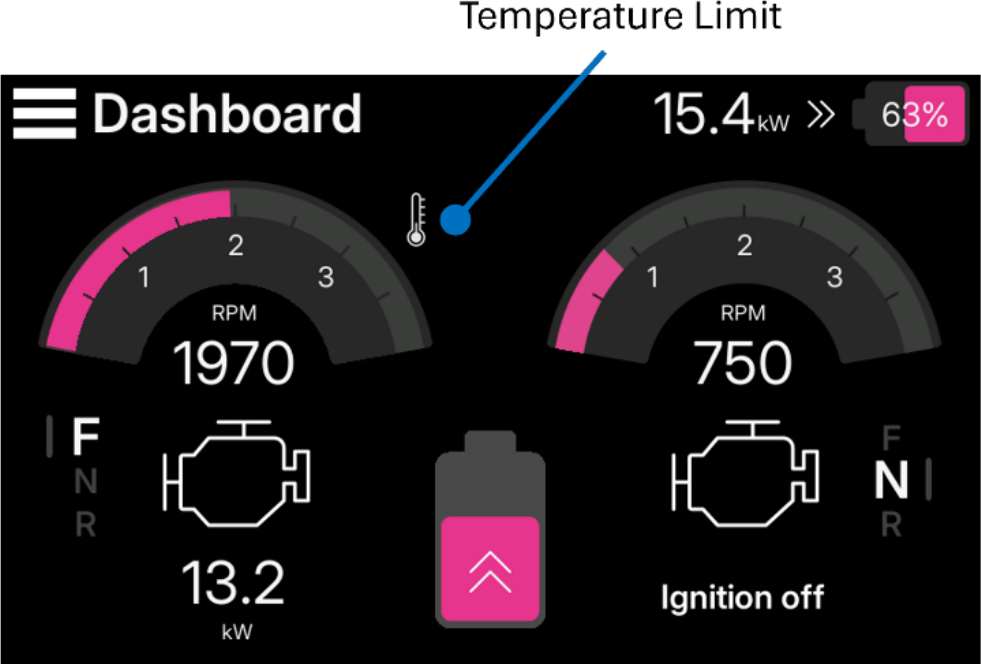
When power is limited by temperature, a thermometer symbol appears on the touchscreen.
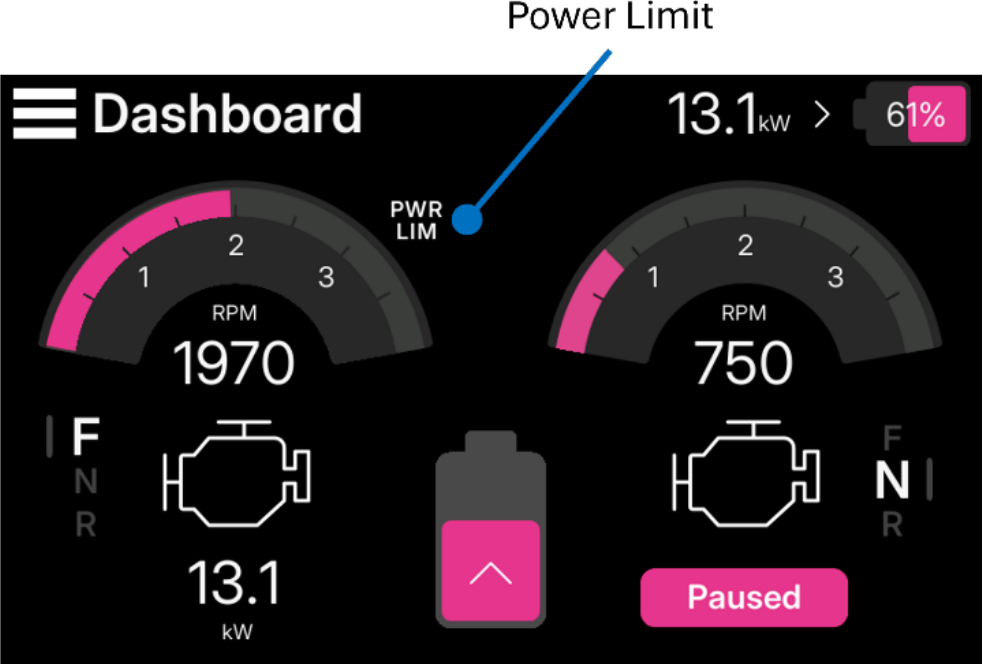
When power is limited by a factor other than temperature, a PWR LIM symbol appears on the touchscreen. Press PWR LIM to learn what is limiting power.
¶ How to Drive with the E-Drive motor?
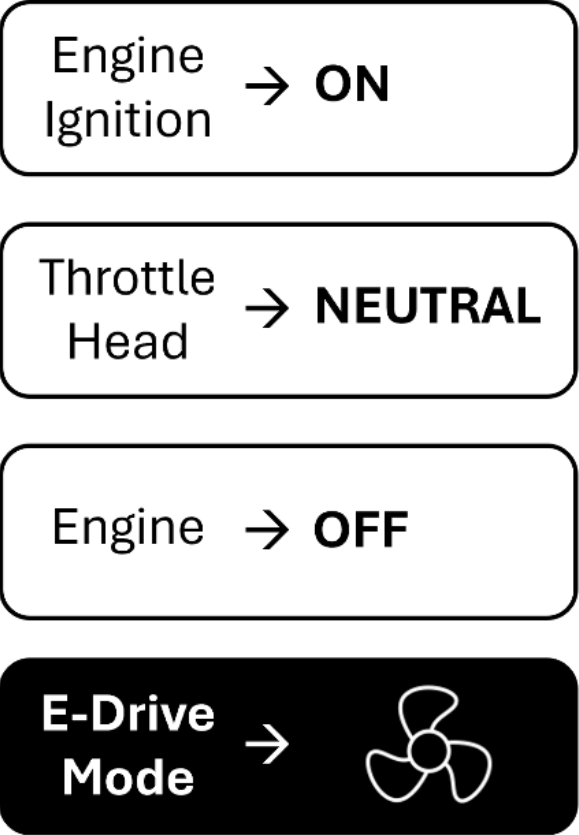
The engine ignition must be turned on, but the engine does NOT need to be running while using electric drive. To drive with the E-Drive motor:
- Turn the engine ignition on.
- Move the throttle to the neutral position.
- Select Drive Mode on the E-Drive screen.
- Wait until the System initialising dialog is no longer shown on the user interface
- Move the throttle into forward (or reverse) idle in-gear, then increase the throttle demand as required. Note that the E-Drive motor does not operate with the gearbox out of gear (e.g. in "warm-up" mode)!
Electric drive continues until:
- The battery state of charge reaches the minimum charge limit set on the E-Drive screen, OR
- The battery indicates it is unable to continue discharging; typically because the battery has reached a minimum charge limit.
¶ What Limits Drive Speed?
Drive speed and the amount of battery power used when driving depends on several factors, including:
- Throttle demand. Low throttle demand uses minimal power, wide open throttle uses maximum power.
- Battery discharge capability. The power discharge capability of the battery bank.
- Screen setting. The drive power limit set on the E-Drive screen.
- Temperature. The E-Drive motor is air-cooled and heats up with time as it runs. When the motor reaches maximum operating temperature, drive speed is reduced to avoid overheating.
- Propeller load. As the propeller speed increases, the mechanical load on the E-Drive motor increases. Maximum speed is reached when the propeller load increases to the point that it consumes all of the power available from the motor. To learn more, read the section How Does E-Drive Work?
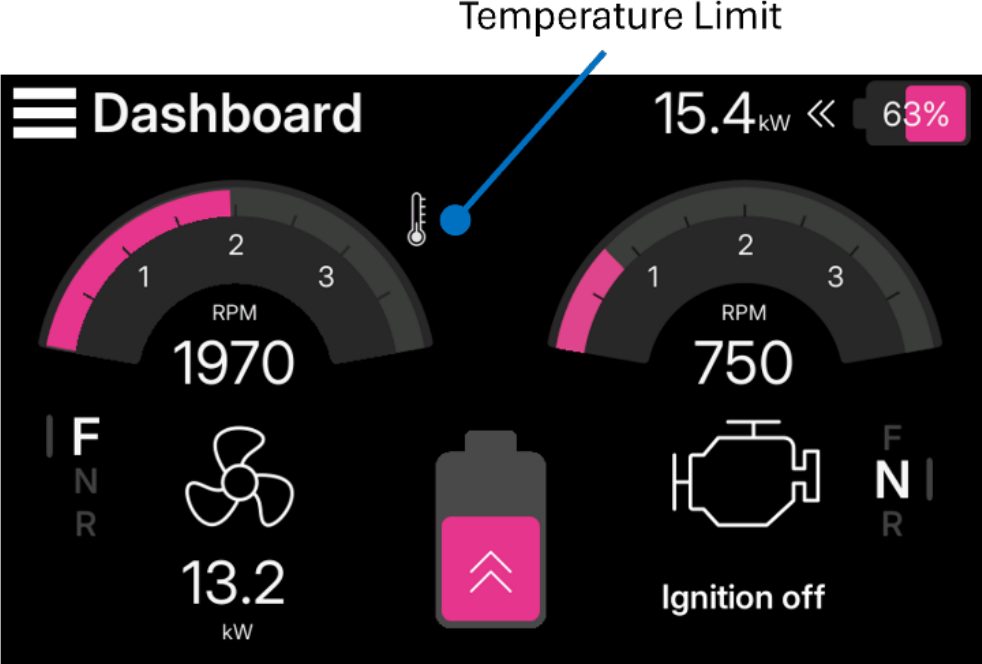
When drive speed is limited by temperature, a thermometer symbol appears on the touchscreen. On the Helm Screen, a LIMIT icon appears and the power figure flashes red/white.
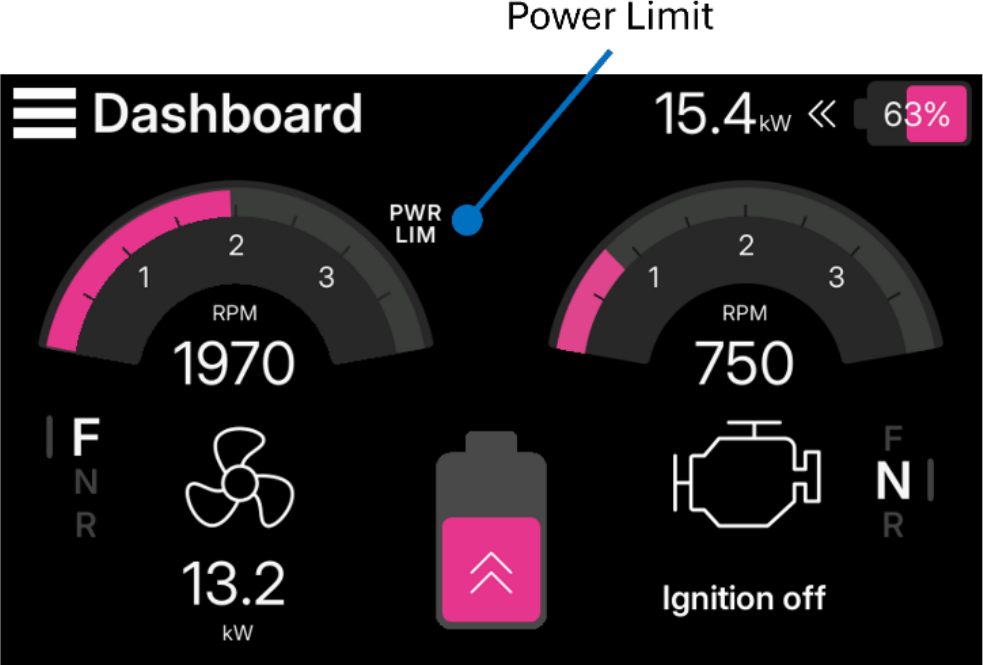
When drive speed is limited by a factor other than temperature, a PWR LIM symbol appears on the touchscreen. Press PWR LIM to learn what is limiting drive speed.
¶ Hybrid Operation: One Engine Driving Two Hulls
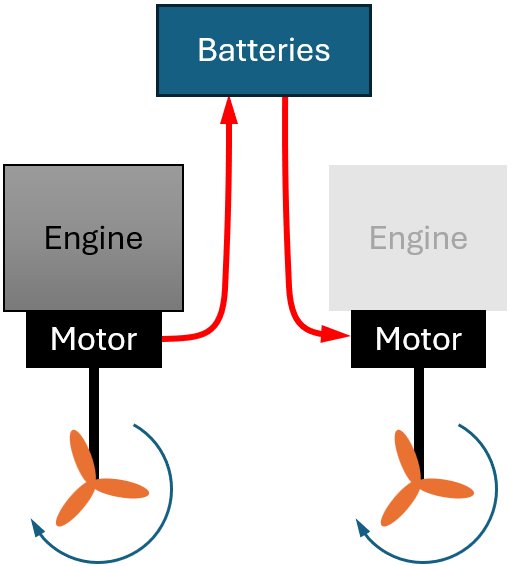
A dual E-Drive system installed on a catamaran can use the engine in one hull to generate power and drive, and with the power generated, drive the other hull with the E-Drive motor; and as an added bonus, charge the batteries with any surplus power!
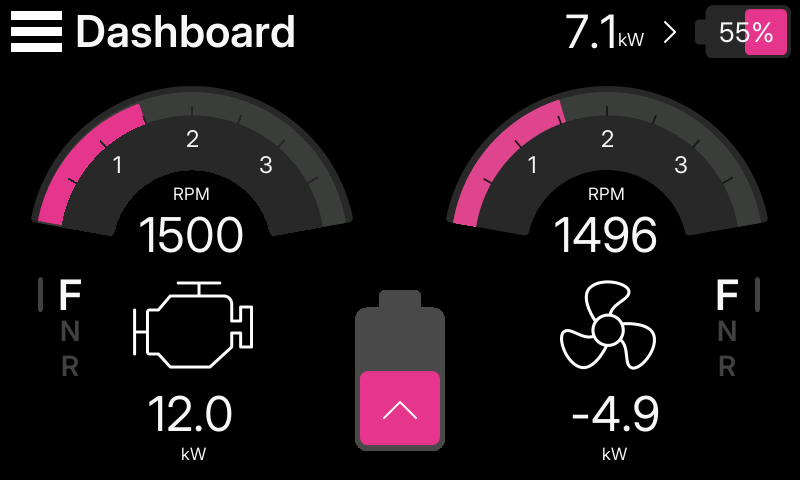
Let's look at an example to illustrate how this works. The example below shows:
- the port engine running at 1500 RPM in-gear with E-Drive generating 12.0kW, and
- the starboard E-Drive motor driving near 1500 RPM (with the starboard engine turned off).
Since the starboard E-Drive motor only consumes 4.9 kW power, the surplus 7.1 kW power generated by the port E-Drive system is used to charge the batteries.
More information is available about the benefits of Hybrid motoring in the Integrel E-Drive Performance Series, Part 3: Intelligent Hybrid Motoring.
User Interface ⟵ | User Guide Contents | ⟶ How E-Drive Works